Random train journeys I made this year
About halfway through 2026, I picked up a new hobby. I’ve started going on train journeys for fun. What I mean is that I look at train routes starting somewhere not too far from my current location and travel on some of the routes I consider interesting. There are a couple of reasons I started doing this. Firstly, it was exam season and I was looking for ways I could force myself to do revision and I figured if I took train journeys for no reason that I would be more motivated to revise on the train (this didn’t prove very effective but I enjoyed the journeys). Another reason is that I have watched people on YouTube like Geoff Marshall, Nick Badley and The Right Track who often make train journeys for fun. After watching enough of these videos I just couldn’t resist making some journeys myself. I also wanted to do this because I realised I wanted to see more of the UK’s train stations and explore more of the country I live in.
Since making my first journey, I have realised this is really fun and I’m really glad I started doing this. A not-that-effective revision idea led me to taking many new train lines, visiting many new train stations and exploring many new places in the UK. It can sometimes be more relaxing than a train journey I need to make since I don’t really care about train delays or cancellations (and if that happens I get delay repay!).
I’ve made quite a few journeys this year so far and I wanted to write about each one here as a separate post, but I just forgot and procrastinated it for a long time. Since I don’t really know which journey to start with and I want to publish this post without further procrastination I have decided I will write about two journeys I think are interesting (as well as some other train-related things). I will probably start making separate posts for journeys I make in the future but for now, here are two of the more interesting journeys I have made:
Birmingham New Street to Llanfairpwll
 After setting off from Birmingham New Street, the train went through to Shrewsbury, then went through a bit of Wales before briefly returning to England to serve Chester. After this the train went along the north coastline of Wales on the way to Anglesey, the island on which Llanfairpwllgwyngyll is located.
When the train left Chester and started going along the north Wales coastline, I couldn’t look away from the window for a second. That part of the route has some of the most stunning coastline views I have seen from a train. I didn’t know the train would be travelling along pretty much the entire north coastline of Wales until that point and I was very pleasantly surprised. These lovely views went on for a few hours and then I got off the train at Bangor. The train I was on went to Llanfairpwll but my advance ticket split at Bangor, giving me just under an hour to explore the city. Annoyingly, Bangor was one of the few stations on the north coastline of Wales which wasn’t directly on the coast so it took around 20 minutes to walk from the station to the coast, by which point I had to turn back almost immediately. I still got to see some of the landmarks in Bangor including its pier and its university but I had to see all those things very quickly to not miss my next booked train.
I then boarded another train from Bangor going just one stop to Llanfairpwll. Right after boarding the train it became immediately obvious that Llanfairpwll station is quite a small one, since the conductor told me to move towards the front of the train to get off. I then got off at the station and finally saw the famous station sign, with the long name of the village in full:
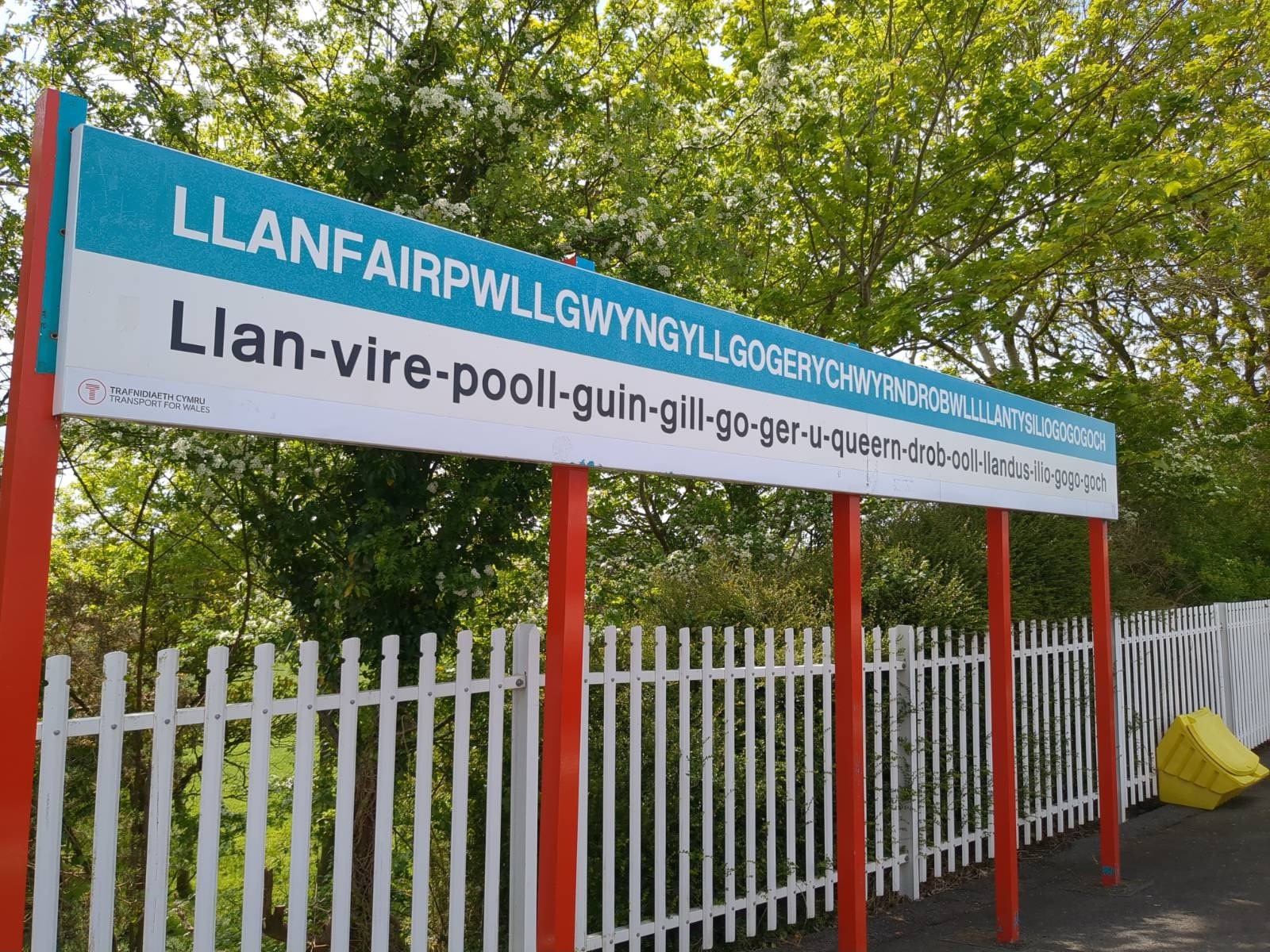
I then awkwardly took a picture while the people on the opposite platform stared in my vague direction and then I left the station to explore the village. First, I went to the souvenir shop by the station, which I had assumed would be quite small based on the photos. It turned out to basically be a mini shopping centre which happened to sell some souvenirs alongside clothes, shoes and other things. I don’t normally buy tourist stuff but I just had to get this very impractical keyring with the name and it’s translation written out in full:

I then explored the village for a few more hours, finding its long name written in various places. After walking for a bit I saw a column just outside the village. This was the Anglesey column and unfortunately I couldn’t climb to the top of it due to some special event there. I also went to the coast and saw the Britannia bridge, a road-rail bridge connecting Anglesey to the rest of Wales (the train I took went along this bridge). I then had some food and took my booked train back to Birmingham, this time without stopping anywhere.
I really enjoyed this journey and really found these Transport for Wales train services quite cool. They start off on a very urban railway line going through Birmingham and Wolverhampton but later go on a very rural Welsh railway line, where some of the stations (including Llanfairpwll) require you to alert the driver or conductor to get on or off the train, almost like you do on buses. If you ever find yourself really bored in Birmingham, this is a journey I can highly recommend.
Reading to Windsor to Reading in a loop
At another point this year, I decided to make some shorter train journeys than I had made before. This was due to the fact that I tended to wake up later in the day and I didn’t want to spend too much money on train tickets. At first I was struggling to think of ideas but then I looked at National Rail’s all stations map and zoomed in on Reading (my nearest major station), to see all the more local lines near there. After doing this I realised that Reading isn’t that far from Windsor and that there are two stations in Windsor: Windsor & Eton Central and Windsor & Eton Riverside.
If you’re travelling from Reading to Windsor, it only makes sense to travel to Windsor & Eton Central since the journey is much shorter and both Windsor & Eton stations are within a short walk of each other. However, I decided to deliberately take a weird route, and travel to Windsor via the Riverside station and back to Reading via the Central station, hence going in a sort of loop.
My round-trip journey cost me around £16 with a 16-25 railcard. This journey cost more since I had to buy one ticket via Staines and another via Slough to complete the loop.
Here is a map of the route (blue is outward, green is return):

So the first train I took was a South Western Railway service from Reading to Staines. I was travelling on a Sunday and it turns out that South Western Railway offer some journeys cheaper on a Sunday via a ticket known as the “Sunday Out Single” which is something I’d never heard of until the site I bought tickets from suggested it to me. After just under an hour I left the train at Staines since there aren’t any direct train services from Reading to either Windsor station. Instead of getting the next train to Windsor & Eton Riverside, I walked around Staines for a bit while I waited for the train after the next one. The reason I did this is because I wanted to be on a train that stopped at Sunnymeads, one of the least used stations in Berkshire. So I got on the slower train out of Staines and went to Sunnymeads:
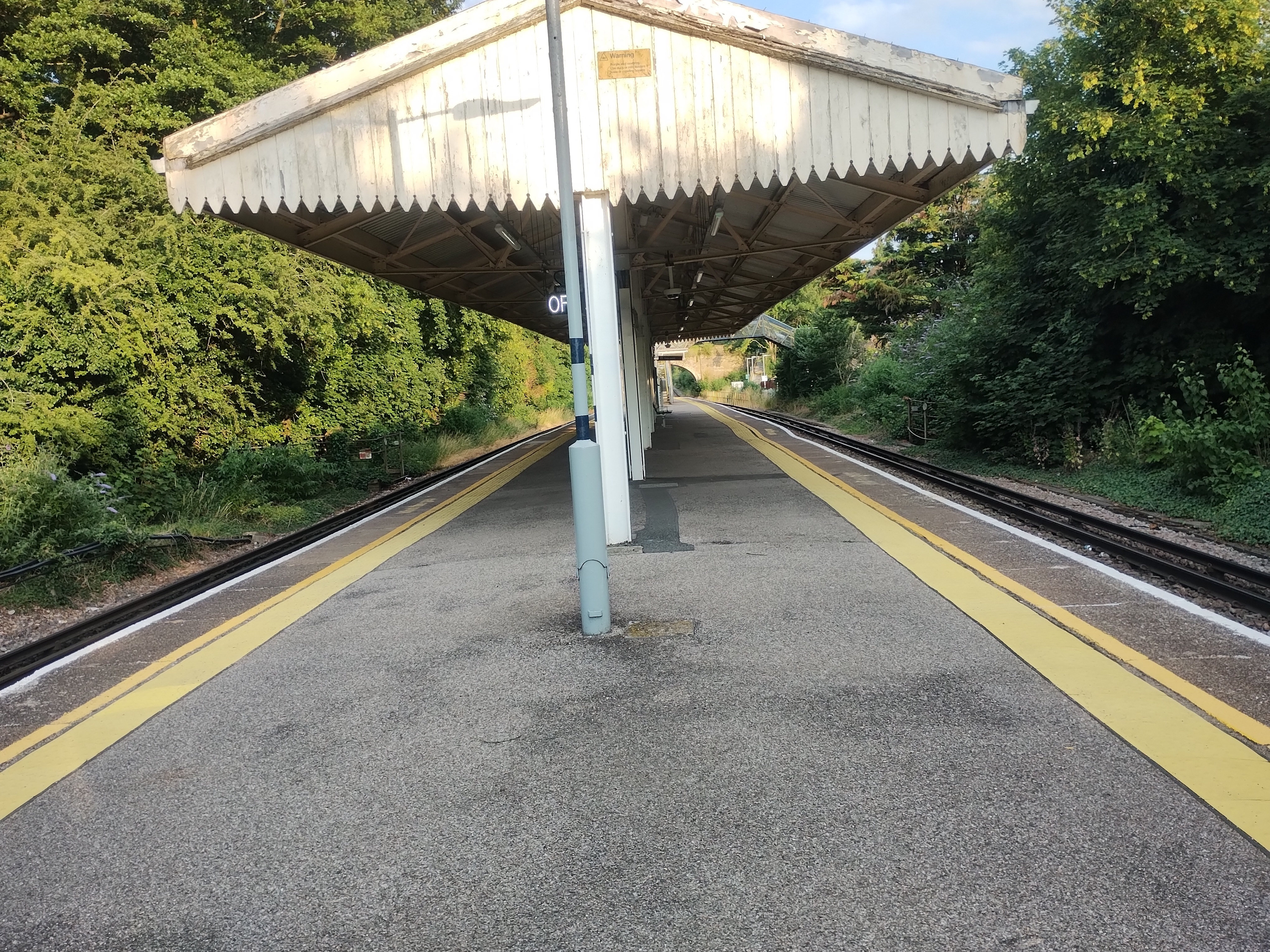
As expected, there aren’t many places you can walk to from Sunnymeads. The only place near the station is a residential area and the nearest village, Wraysbury, has its own train station so you wouldn’t have any reason to get out at Sunnymeads unless you either live near the station, or it’s somehow cheapest to get a taxi from there. It was quite sunny when I was at the station so I guess the name holds true. Since I went there on a Sunday, trains to Windsor & Eton Riverside only ran every hour, so I had to spend an hour walking around one of the least notable stations in Berkshire. I did get to see a pedestrian level crossing without automated barriers, which was quite cool.
After an excruciatingly long hour at Sunnymeads, I got the next train to Windsor & Eton Riverside and I shortly arrived there. As expected, the station is located on the riverside and the area near the station is quite picturesque. I then walked to Windsor & Eton Central, which took less than 10 minutes. That station now only has one platform, and the only train service that runs from there is a Great Western Railway service that is basically a shuttle between Windsor & Eton Central and Slough. I boarded the next train there, and unfortunately had to go to Slough. The route there was quite nice (except for when we got to Slough, of course) and the train went over a viaduct. Fortunately, I only spent around a minute in Slough due to a well timed connecting train and I was quickly headed out of Slough on an Elizabeth Line train back to Reading.
Surprisingly, every single train I took on this journey departed pretty much on time, which is quite rare when you take as many British trains as I took that day.
Other train-related stuff
Where I buy tickets (not sponsored or anything)
The train tickets I buy are usually split fare tickets, which means instead of buying a ticket from A to B, you sometimes buy tickets from A to C and C to B (where C is somewhere along the route from A to B). This often results in cheaper fares without affecting the route of your journey. This is a weird quirk of railways in Great Britain due to how complex the ticketing system is.
The tickets and prices I have talked about here are tickets I bought through Split My Fare. I just use it because it supports split fare tickets and I can use one website to buy tickets for any train in the UK. Most split fare sites are likely to give you similar tickets and prices so just use whichever one you prefer.
I have since then found some more train-nerd friendly ticket sites that I have never used but may be worth checking out. These include RailUKforums tickets and RealTimeTickets. I’ve never used them so I can’t vouch for them but after a quick glance they seem to have some cool features like selecting specific routes or leaving the destination blank. They might be useful for finding routes even if you are buying tickets on another site.
National Routeing Guide
I’ve also briefly looked at the National Routeing Guide, which is a series of documents and maps published by National Rail and allows you to work out what routes from A to B are considered ‘valid routes’. After spending hours figuring out how the guide works I ultimately concluded that I can’t really derive any meaningful information from it since there are way too many exceptions to the rules. Using the guide also requires you to check the fares of journeys and I have no idea about how exactly they expect me to get these fares. I may make a dedicated blog post about the guide if I am ever able to discover anything useful about it.
Where next?
I very much intend to make more train journeys soon, and now I can explore completely different parts of the country since I am now located near a different major railway station: Cambridge.
I have a couple of journeys in mind but the most unique idea I have is to go to Shippea Hill, one of the least used stations in the entire country. The issue is that it’s not used much for very good reasons, there is usually only one train a day there and there is literally nothing of interest to see near the station. If I go there I have to go on a Saturday, since that’s the only day there are two trains running. However, the gap between the two trains is quite large and the train there departs pretty early, so I’ll probably only go there after I’ve spent some more time exploring Cambridge. Other places I might visit are Ely and King’s Lynn.
What I really love about making train journeys like this is that each journey is unique in its own way, with every delay, every cancellation, every random discovery and every unexpectedly scenic view from the window.
… Okay yeah, each post on this blog only makes my neurodivergence more and more obvious